Why flat roofs dominate the Lower Valley
The Lower Valley's older housing stock — from Socorro out through San Elizario and Fabens — was built overwhelmingly with flat or low-slope roofs. These roofs are economical and well suited to the desert's low rainfall, but they are unforgiving of drainage mistakes. Where a pitched roof sheds water off the edge, a flat roof has to move water to a specific drain, and any low spot that holds water longer than 48 hours becomes a structural problem.
Ponding water is not just a nuisance. It adds roughly five pounds of weight per square foot for every inch of standing water, it accelerates membrane breakdown, it grows algae that darkens the surface and increases heat absorption, and it eventually finds the smallest seam weakness to leak through.
The two real fixes
A silicone coating system is the right answer when the existing membrane is fundamentally sound but aged. The roof is cleaned, minor blisters and splits are patched, and a fluid-applied silicone layer is rolled or sprayed across the entire surface. Silicone is fully adhered, seamless, and highly reflective, which lowers summer roof temperatures dramatically. It is a fraction of the cost of a full tear-off and can add a decade of service life.
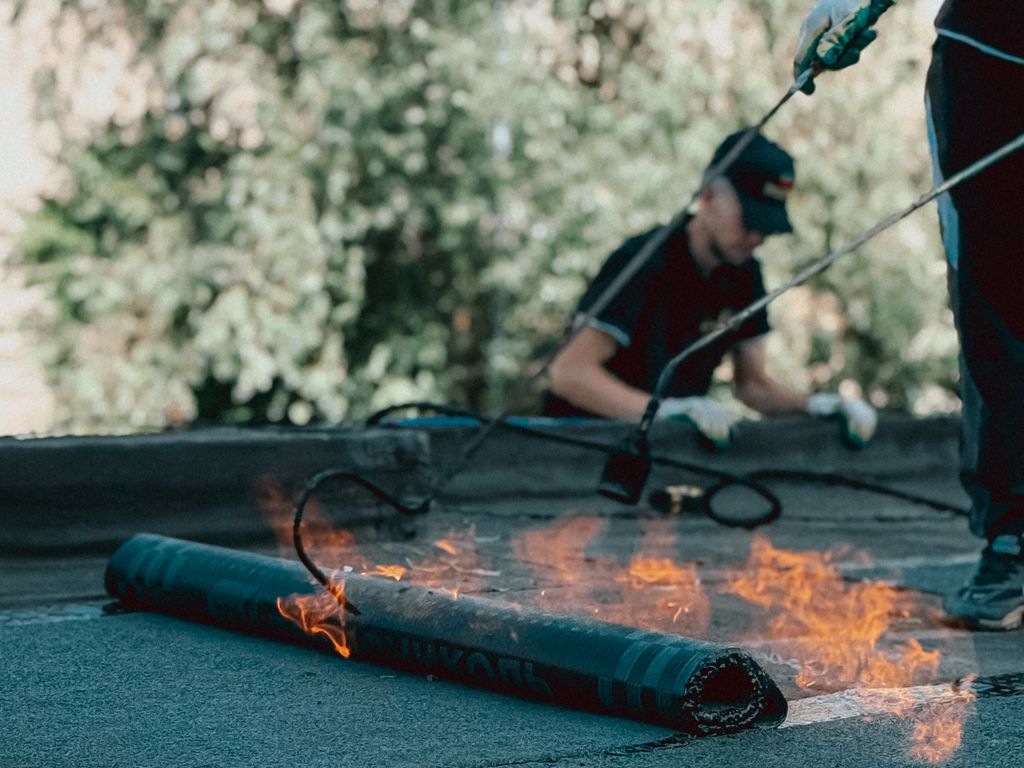
A full TPO overlay is the better choice when the existing membrane has failed across large areas, when the insulation beneath is wet, or when the roof has reached the end of its design life. TPO (thermoplastic polyolefin) is a single-ply membrane heat-welded at the seams, producing a continuous watertight sheet that handles standing water far better than older built-up systems. It costs more than a coating but less than a traditional built-up rebuild.
Drainage comes before membrane
No coating or membrane will survive a roof that ponds water. Before any membrane work begins, the deck needs to be evaluated for slope. Tapered insulation systems can be installed to redirect water toward drains, and additional scuppers or interior drains can be added where the roof currently pools.
Drains and scuppers must be sized for monsoon volume, not average rainfall. An undersized drain that handles a normal rain fine will overflow during a 20-minute desert downpour and send water over parapet walls and into the structure.
Keep drains clear. The single most common cause of a flat roof leak in the Lower Valley is a scupper blocked by a mesquite leaf dam built up over the dry months. A twice-yearly clearing prevents most flat roof failures.
Choosing between the two
If the roof is under 12 years old, drains properly, and has only localized failures, a silicone coating usually wins on cost and longevity. If the roof is older than 15 years, has widespread cracking, or has had multiple patch jobs, a TPO overlay is usually the more durable investment.
The only way to know for certain is an on-deck inspection that probes the insulation for moisture. A roof can look dry from the surface and be saturated underneath, and coating over a wet deck traps the moisture and accelerates the rot. Never let a coating be applied before the deck is checked.
Need a roofer to look at your El Paso home? Get a free quote today.